
Supply Chain Sustainability
Basic Policy for Purchasing and Procurement
It is an important social responsibility to provide superior products in a sustainable and stable manner to satisfy customers. We believe that to fulfill this responsibility, it is vital to improve the quality of our purchasing and procurement of raw materials, components, and services, and we have therefore established the Basic Policy for Purchasing and Procurement with the aim of forging sound relationships with suppliers. We have also determined the Basic Stance of Persons in Charge of Purchasing and Procurement that describes in specific terms how purchasing/procurement personnel should behave to ensure that they do not establish inappropriate relationships with suppliers, and to promote initiatives based on cooperation with the aim of sustainable purchasing and procurement.
Basic Policy for Purchasing and Procurement
- 1.Compliance with laws and regulations
The Teijin Group observes laws and regulations of respective countries and endeavors to understand and respect international norms and guidelines in conducting its procurement activities.
- 2.Fair trade
The Teijin Group endeavors to engage in highly transparent transactions that are just and fair, and does not participate in cartels or bid-rigging.
- 3.Basis of product and supplier assessment
The Teijin Group, in addition to quality, prices, delivery dates, and procurement periods, properly assesses the financial situation, technological capabilities, social responsibility initiatives, etc. of suppliers, and engages in transactions that are based on rational decision-making.
- 4.Human rights/Labor
The Teijin Group promotes purchasing and procurement from suppliers that respect human rights and do not commit human rights infringements such as unjust discrimination, slave labor, forced labor, child labor, human trafficking, etc.
- 5.Safety and Health
The Teijin Group promotes purchasing and procurement from suppliers that properly manage health and safety risks and take action to improve occupational health and safety on an ongoing basis.
- 6.Environment
The Teijin Group promotes purchasing and procurement from suppliers that practice environmental management by, for example working to conserve the environment and protect natural resources.
- 7.Blocking of relationship with antisocial forces
The Teijin Group blocks relationships with antisocial forces such as crime organizations, refuses inappropriate requests, and does not provide them with money.
- 8.Relationship with stakeholders
The Teijin Group proactively communicates with stakeholders and promotes sustainable purchasing and procurement based on cooperation grounded in trust relationships. Furthermore, the Teijin Group collaborates with suppliers to promote initiatives based on the CSR Procurement Guidelines.
(Established September 1, 2006; Revised November 1, 2017)
Basic Stance of Persons in Charge of Purchasing and Procurement
- 1.Compliance with laws and regulations
Purchasing/procurement personnel observe relevant country laws and regulations. In addition, they will constantly monitor international norms and guidelines, industry standards and their trends and strive to respect them in engaging in transactions.
- 2.Fair trade
- (1)Purchasing/procurement personnel do not participate in cartels or bid-rigging, and endeavor to maintain sound relationships with suppliers. They also do not abuse their status to demand inappropriate discounts, services, contributions, etc.
- (2)Purchasing/procurement personnel do not have personal interests with any supplier, and do not accept personal benefits such as rewards or gifts.
- 3.Information security
Purchasing/procurement personnel carefully manage confidential information relating to transactions and safeguard intellectual property rights.
- 4.Basis of product and supplier assessment
Purchasing/procurement personnel rigorously assess goods and services, and engage in transactions where consideration is given to quality, prices, delivery dates, and procurement periods, as well as the financial situation, technological capabilities, corporate approach, and social responsibility initiatives of the suppliers.
- 5.Human rights/Labor
Purchasing/procurement personnel do not force inappropriate transaction terms on suppliers nor force them to accept unreasonably low prices, etc. and promote purchasing and procurement from suppliers that respect human rights and do not support forced labor or long working hours.
- 6.Safety and Health
Purchasing/procurement personnel promote purchasing and procurement from suppliers that ensure occupational health and safety and take action to maintain and improve the health of their workers.
- 7.Environment
Purchasing/procurement personnel promote green purchasing and procurement and purchasing/procurement of environmentally-friendly products and services.
- 8.Blocking of relationship with antisocial forces
Purchasing/procurement personnel adopt a firm attitude toward criminal organizational and other antisocial forces, not allowing their involvement, and blocking any and all relationships with them.
- 9.Relationship with stakeholders
Purchasing/procurement personnel collaborate with suppliers to promote initiatives based on the CSR Procurement Guidelines. Furthermore, they endeavor to ensure suppliers' understanding of the Guidelines and collaborate with suppliers with regard to initiatives for improvement.
(Established September 1, 2006; Revised November 1, 2017)
CSR Procurement Guidelines
To manufacture and distribute its products, the Teijin Group procures a large amount and wide variety of raw materials, equipment, components and services from many companies around the world. Furthermore, to realize a sustainable supply chain globally, we have established the CSR Procurement Guidelines as one of the criteria for determining whether it is advisable to conduct business. We require our suppliers to conduct activities in compliance with our guidelines. When selecting suppliers, we adhere to our purchasing guidelines based on fair and rational judgments.
CSR Procurement Guidelines
With regards to the Teijin Group’s purchasing and procurement activities, we request that suppliers take the following action. In addition, we will promote to purchase and procure from suppliers that have been taking these actions.
- 1.Quality and safety
Products must meet safety and quality standards prescribed under laws and regulations in individual countries as well as industry standards.
Chemical additives must be properly managed, and by, for example, obtaining external certification such as ISO 9001.
Furthermore, a quality management system must be deployed and continuously maintained and improved to promote quality assurance. - 2.Human rights and labor
- (a)Forced labor
Slave labor, human trafficking, debt bondage, labor based on violence, threats, or political oppression, or any other form of forced labor is prohibited. - (b)Child labor and young workers
Children under the age of 15 years must not be hired in any country in which you have activities. Furthermore, you must not allow young workers between the ages of 15 and 17 to work at night, work overtime, or perform work that puts their health or safety at risk. You must also pay young workers appropriate remuneration and respect their right to learn. - (c)Foreign workers
Foreign workers must be provided with an employment contract and rules of employment in languages which employees can understand. Employers and temporary staffing agencies (including business cooperatives and nonprofit organizations) must not confiscate and prevent the use by workers of government-issued identity cards, passports, and work permits (unless holding work permits is required by law) as well as migrant applications. Furthermore, employers and temporary staffing agencies must not charge fees to workers. - (d)Working hours and holidays
Working outside regular hours (overtime, working on holidays, etc.) is only permitted if the worker agrees to it. Except under special circumstances, workers cannot be required to work more than the maximum weekly working hours prescribed under local laws and workers must be given at least one contiguous 24-hour period off per week. Furthermore, paid holidays and statutory holidays must be provided in accordance with local laws. - (e)Wages and welfare benefits
After explaining the components of wages and the method used for calculating them, you must pay workers at least minimum wage. You must also provide statutory welfare benefits. Wages for work performed outside regular hours must be calculated in accordance with applicable laws and must be higher by a reasonable percentage than wages for regular work. - (f)Discrimination
Recruitment, remuneration, welfare benefits, training opportunities, work duties, promotions/wage increases, and discipline/dismissal must not be influenced by race, nationality, gender, religion, age, disability, marital status, family background, organizations joined, gender identity, sexual orientation, or political ideology. You must implement measures for preventing discrimination such as providing training to all workers. - (g)Harassment
Workers must be treated with respect and dignity, and must not be exposed to any sort of harassment or pestering. You must implement measures for preventing harassment such as providing training to all workers. - (h)Freedom of association
The right of workers to freely exercise the right to organize and the right to collective bargaining must be recognized. You must also make efforts to resolve labor disputes and engage in effective and periodic communication with workers and their representatives.
- (a)Forced labor
- 3.Safety and Health
- (a)Permits relating to labor safety and health
You must apply for permits relating to labor safety and health for facilities and operations that require them and assign licensed personnel in accordance with laws, regulations, etc. in order to properly manage them. - (b)Sanitary facilities
You must endeavor to maintain the health of employees in order to prevent diseases and occupational accidents. Workers must be provided with a safe and hygienic working environment, and access to sanitary facilities such as toilets and dining rooms must not be unjustly restricted. Furthermore, dormitories for workers must be equipped with proper sanitary facilities and kept clean. - (c)Preparedness for emergencies
To prepare for emergencies, workers must be provided with training concerning notifications and evacuation procedures, and proper equipment such as fire extinguishers and fire alarms must be installed and maintained. In other words, efforts must be made to minimize damage in the event of an emergency. - (d)Safety training
Proper training concerning workplace health and safety must be provided on an ongoing basis in languages which employees can understand. Furthermore, information relating to health and safety must be clearly displayed in the workplace. - (e)Measures to ensure the safety of machinery
Machinery needs to be assessed for safety risks. If there is a risk of workers suffering injury due to machinery, physical protection measures must be implemented such as guard rails, interlocks, protective walls, etc. as required and the machinery concerned must be properly maintained and managed. - (f)Occupational health
The risk which chemical, biological, and physical substances will influence workers must be identified, assessed, and managed. We also recommend that all workers receive a medical examination by the frequency pursuant to laws or at least once a year, whichever is more. - (g)Occupational accidents
Classification and records of injuries resulting from occupational accidents and illnesses must be kept, the necessary treatment must be provided, the causes of occupational accidents must be investigated, corrective action must be taken to eliminate the causes of them, and a process must be followed for enabling workers to return to the workplace. - (h)Occupational health and safety management system
A management system for occupational health and safety, such as one based on ISO 45001, must be deployed and internal audits must be performed in order to facilitate ongoing improvements in occupational health and safety. We also recommend the management of health and safety risks.
- (a)Permits relating to labor safety and health
- 4.Formulation of business continuity plan
We recommend that a business continuity plan be formulated and strategically administered to allow business operations to continue or be promptly restarted in the event of a disaster or accident. - 5.Fair trade and ethics
- (a)Prohibition of bribery
The exchange or provision of entertainment, gifts, or money for the purpose of illicit gain in the course of engaging in transactions is prohibited. You must also formulate and implement a policy and measure for preventing corruption, bribery, and extortion. - (b)Fair business
You must not engage in private monopoly, inappropriately restrict trading (through cartels, bid-rigging, etc.), employ unfair business methods, or abuse your status, and you must comply with competition laws in individual countries and territories. You must also confirm legal or regulatory developments that apply to your company and inform workers about them. We also recommend that you provide all workers with training on fair trading and ethics. - (c)Intellectual property
You must endeavor to safeguard and utilize your company’s intellectual property rights. Furthermore, you must not unjustly infringe the intellectual property rights of other companies. - (d)Information disclosure and presentation You must properly disclose or display information concerning labor, health/safety, and environmental initiatives, business activities, financial condition, products, and corporate structure and performance in accordance with applicable regulations, etc.
- (e)Information security
You must only obtain personal information and confidential information using appropriate methods. You must also strictly manage and protect it, and only use it within a reasonable scope. - (f)Conflict minerals
You must take care that minerals that you procure or that are used in your products do not provide any sourcing of finance for armed groups or organizations involved in human rights violations, environmental disruption, corruption, etc. in conflict regions and high-risk areas. In particular, “conflict minerals” must not be used in principle.- *Conflict minerals: Designated metal ore (gold, tin, tantalum, and tungsten) mined in conflict regions and high-risk areas with the concern to provide sourcing of finance for armed groups or organizations involved in human rights violations, environmental disruption, corruption, etc.
- (g)Blocking of relationships with antisocial forces
You must adopt a firm attitude toward criminal organizations and other antisocial forces, not allowing their involvement, and blocking any and all relationships with them.
- (a)Prohibition of bribery
- 6.Export control Compliance
With regard to products or technologies subject to your national export control laws and/or regulations and other applicable export control-related laws and regulations of other countries, you must implement thorough measures to ensure that you comply with them and are not involved in illegal exports. - 7.Environmental conservation
- (a)Action on climate change
You must endeavor to devise methods for improving energy efficiency and minimizing the consumption of resources. You must also identify current emissions of greenhouse gases by each of your facilities and by your company as a whole and take action to reduce them. - (b)Permits relating to environmental conservation (air, wastewater, noise, vibration, etc.) You must apply for environmental-conservation-related permits for facilities and operations that require them and assign licensed personnel in accordance with laws, regulations, etc. in order to properly manage them.
- (c)Minimizing environmental impact (air, water, soil)
To prevent air, water, and soil pollution, you must manage and treat discharged substances. - (d)Management of chemical substances Chemical substances that could cause environmental pollution must be managed safely. Chemical substances that are prohibited under the laws and regulations of individual regions and territories must not be used. Furthermore, regarding the substances whose use has been limited by laws and regulations you must notify customers of whether those substances are contained in products. In addition, SDS must be issued and updated.
- (e)Waste reduction (3Rs)
You must pursue the 3Rs(reduce, reuse, and recycle) in order to reduce waste and byproducts. - (f)Water usage control
You must manage water intake and water discharge and you must strive to optimize water usage. - (g)Environmental management system
You must formulate an environmental policy, take action and develop products, raw materials, and technology for preventing pollution, and make efforts to conserve the environment. We also recommend that you conduct internal audits, obtain certification, such as ISO 14001, for your environmental management system, and perform environmental impact assessments. - (h)When purchasing or procuring products or services, we recommend that you consider the environment, and purchase and procure from suppliers that are endeavoring to reduce environmental impact such as by selecting products and services with the minimum environmental impact.
Regarding hazardous substances found in raw materials, these must be managed in accordance with the Teijin Group's "Substances Prohibited to be Procured" and "Substances Principally Prohibited to be Procured."
- (a)Action on climate change
- 8.Consideration for local communities
When conducting business in local communities, we recommend that you engage in dialog with local residents (including indigenous peoples) in advance and adapt your business activities to suit the community. - 9.Contact point for consultations and internal reporting
You must deploy and operate a system for seeking advice and internal reporting that ensures that its users need not fear retribution, such as by being forced into a disadvantageous position. We recommend that you install a neutral advice and internal reporting point operated by the third party to protect internal reporters and prevent retribution. - 10.Responsible supply chain promotion
You must inform your suppliers about the contents of these guidelines and you must endeavor to ensure compliance. We also recommend that you monitor compliance and work together with suppliers to address inadequacies.
(Established May 7, 2007; Revised September 1, 2022)
Green Purchasing
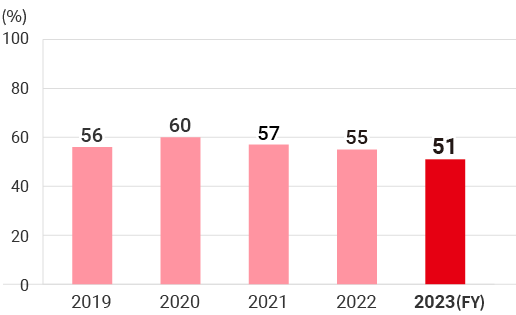
The Teijin Group established the Green Purchasing Policies and Green Purchasing Guidelines in March 2001 to promote green purchasing (preferential purchasing) of environment-friendly products and services. For office supplies, we have promoted the preferential purchasing of products meeting the requirements of the Green Purchasing Standards for Office Supplies, also established by the Teijin Group. Cost reductions and an expansion of green purchasing products was broadly implemented across Group companies. However, the ratio of green purchases in FY2025 decreased slightly compared with FY2024.
Green Purchasing Policies
- 1.Fully consider the necessity of purchasing before buying a product or service. Curtail the quantity as much as possible when purchasing.
- 2.Purchase environmentally friendly products and services based on an assessment of their entire lifecycle, including collection of resources, manufacture, distribution, use, disposal, and recycling.
- 3.Give preference to suppliers that are active in environmental conservation.
- 4.Pursue environmental information necessary for making decisions on green purchasing from a broad range of sources, and request that manufacturers and distributors provide such information.
Green Purchasing Guidelines
- 1.Reducing environmental pollutants
- (1)Ensure that we do not use substances whose manufacture or usage is prohibited by law (e.g., PCBs)
- (2)Ensure that there is little possibility of emitting pollutants into the environment that could adversely impact the environment and people's health at all stages of the product life cycle
- 2.Saving resources
- (1)Limit the consumption of finite resources such as metal resources and fossil fuels (oil, coal, etc.)
- (2)Extract sustainable resources, such as forest resources, using sustainable methods with minimal impact on ecosystems and make effective use of such resources
- (3)Strive to reduce the size and weight of products
- 3.Saving energy
- (1)Adopt manufacturing methods that only consume small amounts of energy sources such as fossil fuels (oil, coal, etc.)
- (2)Promote energy conservation at the logistics and use stages
- 4.Long durability
- (1)Consider the long-term use of durable consumables from perspectives such as ease of maintenance, length of maintenance service, and expanded functionality
- 5.Recyclability
- (1)Use materials that can be easily reused and recycled
- (2)Strive to reduce the types of materials used and to make material use more consistent
- (3)Ensure the simple organization of reusable and recyclable materials
- (4)List material names for reuse and recycling
- (5)Establish easy-to-use systems for collection and recycling
- 6.Regenerated materials, etc.
- (1)Make use of numerous products and materials that have been recycled or restored
- 7.Ease of treatment and disposal
- (1)Design final treatment/disposal processes that give consideration to minimizing burden on the surrounding environment and on treatment and disposal facilities
Survey of Suppliers for Sustainable Procurement
Implementation of Surveys
The Teijin Group evaluates its suppliers' activities relating to Corporate Social Responsibility (CSR) through questionnaires, on-site assessments and other survey activities conducted with key suppliers. These surveys assess matters relating to human rights, labor practices, occupational health and safety, ethics and other topics based on the requirements set out in the Teijin Group CSR Procurement Guidelines and internationally recognized human rights and labor standards. Based on the results of these surveys, we assess the human rights risks of our suppliers. In FY2025, we conducted CSR procurement questionnaire surveys for suppliers selected in accordance with the criteria established by each business, including key suppliers and suppliers with a certain level of transaction volume. Based on the survey results, we conducted detailed reviews of approximately 120 suppliers that were assessed as having higher risk and requested corrective actions where necessary. In addition, in the Fibers & Products business, which is recognized as a business area where human rights issues are more likely to arise, TA Frontier conducted CSR procurement questionnaire surveys of suppliers in Japan and overseas. Based on the survey results and other relevant information, TA Frontier also carried out on-site assessments at 17 processing factories, sewing factories and similar facilities during FY2025.
Evaluation method
Suppliers are ranked according to their score percentage. For suppliers with a low overall evaluation or those who had issues identified in the predetermined key questions*, we implement follow-up activities which include requests for improvement and on-site investigations.
- *Key questions: "Confirmation that no forced labor is involved," "Confirmation of the presence or absence of conflict minerals," etc.
FY2025 Results
In FY2025, we sent our questionnaire to 1,653 suppliers and received responses from 853 suppliers (response rate: 51.6%). Among the respondents, 119 suppliers (14.0% of responding suppliers) with low overall ratings or low scores on human rights-related questions were designated as priority targets for improvement efforts, and we confirmed the details and requested corrective actions as necessary. We also conduct a streamlined version of the CSR Procurement Survey before commencing business with new suppliers.
Summary of the FY2025 CSR Procurement Questionnaire Survey
| Distribution of questionnaire (A) |
Number of respondents (B) |
Number of suppliers asked to submit improvement plans (C) |
Number of improvement plans received (D) |
|---|---|---|---|
| 1,653 companies | 853 companies | 119 companies | 79 companies |
| Percentage | 51.6% (B) / (A) |
14.0% (C) / (B) |
66.4% (D) / (C) |
Survey exemption for excellent suppliers
For excellent suppliers that have been assessed as low risk based on past survey results, the Teijin Group sends the CSR Procurement Guidelines instead of conducting a questionnaire survey, and simplifies follow-up procedures through receipt of an acknowledgement of the Guidelines.
Care for Contractors and Work Contracts
The Teijin Group strives to maintain appropriate contractor relationships through mutual cooperation with its outsourcing partners. The Group respects the rights and positions of workers and gives due consideration to labor compliance, human rights, and occupational health and safety. To maintain these standards, awareness-raising and educational activities are conducted regularly at worksites.
Examples of Supplier Improvements Achieved through the Surveys and Audits
The CSR Procurement Survey for suppliers included a question regarding the management methods for identification documents and passports of foreign national workers. We requested improvement to an overseas company, as they had answered that these documents were kept within the company and not returned to the workers until their employment contract periods were completed. With our request, methods were improved so that each worker retains their original documents and the company stores copies of these documents only when necessary. Another case in which we requested improvement was a Japanese supplier who had not created work rules in a language their foreign national workers could understand. The Japanese supplier responded by creating and distributing its work rules in foreign languages.
Supply Chain Seminar
CSR Supply Chain Seminar Held to Strengthen CSR Procurement Initiatives
In Fibers & Products Converting, TA Frontier has held annual CSR Supply Chain Seminars since 2014 for processing, sewing and embroidery factories, material manufacturers, and other suppliers in Asia and Japan, with the aim of promoting legal compliance and the protection of human rights among suppliers. In FY2025, seminars were held in Vietnam, China, and Japan. The Teijin Group believes that it is important to continuously raise awareness of CSR procurement at the local level.
Results for FY2025
Seminar (Japan)
On July 22, 2025, we held an online seminar for our Japanese business partners. A total of 99 participants from 88 companies attended the seminar, which was held with the cooperation of Energetic Green, the International Labour Organization (ILO) Office for Japan, and the General Incorporated Association unisteps. The specific themes were as follows.
- 1.Sustainable Procurement Trends and Latest Information on the Specified Skilled Worker System
- 2.Aiming for Sustainable Businesses Through Respecting Human Rights
- 3.Fashion and Sustainability
- 4.Panel Discussion: Sustainability Required in the Textile Industry
Seminar (China)
On April 25, 2025, we held a seminar for our suppliers in China. A total of 42 participants from 30 companies attended the seminar, which was held with the cooperation of Energetic Green, Inno Community Development Organisation, and the Beijing DHH Law Firm (Qingdao). The specific themes were as follows.
- 1.Sustainable Procurement Trends
- 2.China Hotline Cases and Methods of Resolution
- 3.Management of Factory Waste and Pollutant Permits
Seminar (Vietnam)
On December 11, 2025, we held a seminar for local sewing and embroidery factories and material manufacturers located in Ho Chi Minh City, Vietnam. A total of 43 participants from 16 companies attended the seminar, which was held with the cooperation of the International Labour Organization (ILO), the Vietnam Textile & Apparel Association, and Energetic Green. The specific themes were as follows.
- 1.Aiming for Sustainable Businesses Through Respecting Human Rights
- 2.Initiatives and Best Practices in the Vietnam Textile Industry Regarding Environmental Issues
- 3.Management of Working Hours