
Human Rights
Respect for Human Rights
The Teijin Group is committed to working in accordance with the United Nations (UN) Guiding Principles on Business and Human Rights (hereafter, "UNGPs") established by the United Nations in 2011 and the International Labour Organization (ILO) standards.*
- *It includes endorsement and respect for "the effective abolition of child labour," "the elimination of all forms of forced or compulsory labour," "the elimination of discrimination in respect of employment and occupation," "freedom of association and the effective recognition of the right to collective bargaining" and "a safe and healthy working environment" as ILO Core Labour Standards.
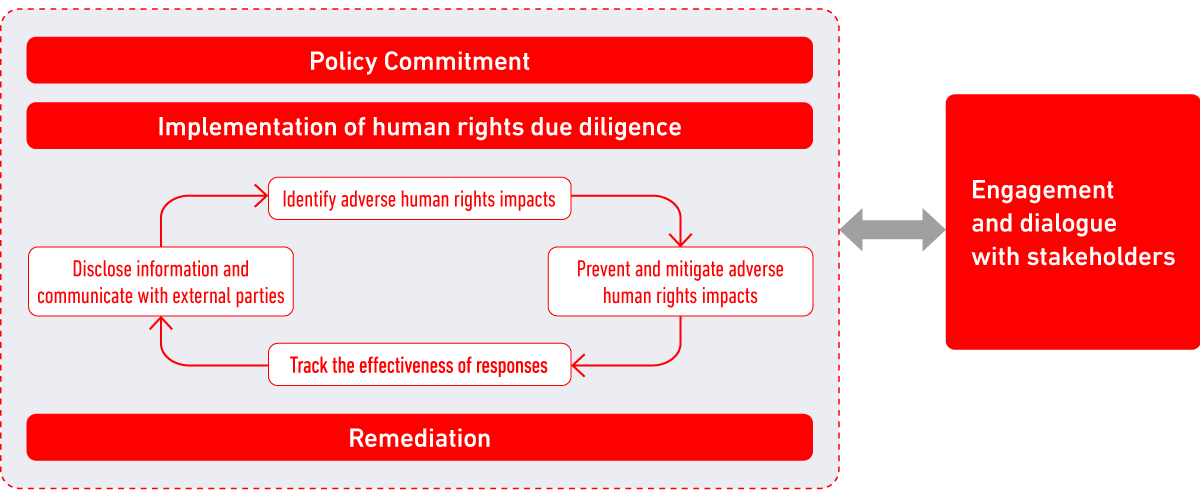
Teijin Group Human Rights Policy
The Teijin Group established the Teijin Group Human Rights Policy as its fundamental stance to respect the dignity and rights of all individuals. The policy was approved by the Board of Directors of Teijin Limited in March 2019.
The Teijin Group Human Rights Policy
The word "Together" in the Teijin Group's Purpose, is to express our desire for our employees to work together with respect for each other's differences and diversity, collaborate with external partners, and to be a company that continues to resonate with various stakeholders including our customers. As our basic stance of respecting every human's dignity and rights, we*1 stipulate the following in this Teijin Group Human Rights Policy.
- 1.Commitment
We recognize that respecting human rights is an important social responsibility that a company must fulfill. We will take action to ensure that we are not directly involved in any abuse of human rights*3, nor indirectly complicit through our relevant external parties*2.
- 2.Foundational principles
We follow the fundamental principles described in the United Nation (UN) International Bill of Human Rights (the Universal Declaration of Human Rights, the International Covenant on Civil and Political Rights, and the International Covenant on Economic, Social and Cultural Rights), and the International Labor Organization (ILO) Declaration on Fundamental Principles and Rights at Work*4.
We respect the UN Guiding Principles on Businesses and Human Rights, the 10 principles of the UN Global Compact and the Children's Rights and Business Principles. - 3.Responsibility
The Chief Executive Officer of the Teijin Group takes responsibility for implementing this Policy.
- 4.Education, Training and Collaboration
We educate and train both our corporate officers and employees to make sure that this Policy is fully embedded in our business and carried out effectively. In addition, we expect our relevant external parties to understand and respect human rights in line with this Policy, and collaboratively respect for human rights.
- 5.Due Diligence
We develop the human rights due diligence process to identify actual or potential negative impacts on human rights and seek to prevent or mitigate these negative impacts.
- 6.Remedy
When we recognize that we directly cause or indirectly influence adverse impacts on human rights, we conduct dialogue with relevant parties and address such impacts through appropriate procedures.
- 7.Disclosure and Dialogue
In our corporate website, we disclose progress and outcome of our efforts to respect human rights. We also conduct dialogue with our stakeholders about our efforts.
- *1“We” means the Teijin Group and its corporate officers and employees.
- *2“Our relevant external parties” are all external organizations and people, including suppliers and partners, with whom we do business.
- *3“The abuse of human rights” incorporates any discrimination on the basis of race, religion, gender identity (SOGIESC, Sexual Orientation, Gender Identity, Gender Expression, and Sex Characteristics), etc.
- *4This includes endorsement and respect for "the abolition of child labour"; "the elimination of all forms of forced or compulsory labour"; "the elimination of discrimination"; "freedom of association and the effective recognition of the right to collective bargaining in respect of employment and occupation,"; and "a safe and healthy working environment," as the ILO Core Labour Standards.
Resolved at the Board of Directors of Teijin Limited held on March 1, 2019
Revised at the Board of Directors of Teijin Limited held on August 3, 2021
Revised at the Board of Directors of Teijin Limited held on July 29, 2025
Human Rights Commitment in the Code of Conduct
In June 2018, the Teijin Group reformulated its Code of Conduct into five items: "Together," "Environment, Safety & Health," "Integrity," "Joy at Work," and "Innovation." We clearly express our commitment to human rights in the section on "Integrity."
- Integrity: We act with integrity in compliance with laws and regulations, and show respect for human rights and local communities in which we operate.
- We respect human rights and do not tolerate any discrimination and harassment in any part of our business and supply chain. We also maintain accountability by ensuring that our business is conducted in a way that helps to win the trust of local communities.
- We comply with applicable laws and regulations in every country and region where we do business, including multilateral laws and regulations, and respect internationally-accepted principles.
With the aim of sharing this Code of Conduct with the entire Teijin Group, in August 2020 we created a video message featuring our CEO which was sent to all our Group companies with subtitles in local languages of all regions and countries in which the Teijin Group operates.
Human Rights Due Diligence
Implementation of Human Rights Risk Assessment (FY2023)
The Teijin Group conducts human rights risk assessments every few years with the aim of identifying human rights risks that may arise throughout its value chain. Following the first assessment in FY2018, a second assessment was conducted from March to December 2023. Based on qualitative information relating to each business, the assessment evaluated geographical risk, product-specific risk, employment-related risk, and industry risk, and quantitatively analyzed the human rights violation risk of each business as the aggregate of these risk factors. Through the 2023 assessment, the Teijin Group confirmed human rights risks across its principal businesses. In particular, the Fibers & Products business is recognized as one of the business areas with relatively higher potential human rights risks within the Group, and priority actions are being taken based on a risk-based approach.
Survey target
The 12 business units of the Teijin Group*
- *1. Aramid, 2. Carbon Fibers, 3. Resin & Plastic Processing, 4. Corporate Business Incubation, 5. Composites, 6. Fibers & Products Converting, 7. Pharmaceuticals, 8. Home Healthcare, 9. IT, 10. Material New Business, 11. Healthcare New Business, and 12. Engineering
Survey method
Analyzing the qualitative information from the 12 surveyed business units, we evaluated geopolitical risk, product-specific risk, employment-related risk, and industry risk, and based on the total assessment of these risks, provided each business unit with a score for human rights violation risk.*
- *Definition of "human rights violation risk" covered by this survey
- 1.This survey focused on "modern slavery," a term used to describe all human rights abuses including slavery, servitude, forced or compulsory labor, and human trafficking.
- 2.In this survey, the following factors were analyzed to gauge modern slavery risk:
- Highly competitive industries, with low barriers to entry and operations in jurisdictions with weak labor laws and ineffective union representation;
- Prevalence of low-skilled workers;
- High number of female workers;
- Documented cases of child labor;
- High proportion of migrant labor in the workforce;
- Documented cases of human trafficking;
- Documented cases of harmful employment practices;
- Documented cases of debt bondage;
- Operation in fragile or conflict affected areas;
- High proportions of refugees in the workforce;
- Operation in countries with highly repressive regimes;
- Industries in which low-skilled labor is used to carry out so-called "three D" jobs (dirty, dangerous, and difficult), such as work involving dangerous or physically arduous manual labor, work involving prolonged periods of repetitive motion, and work that is stigmatized or socially devalued. These jobs are typically carried out by migrants, minorities, or socially marginalized groups that are highly vulnerable to exploitation.
- 3.In this survey, the characteristics of "forced labor" are as follows:
- The illegal withholding and deduction of wages;
- The illegal confiscation of identity documents, such as passports;
- Debt bondage (Forced labor as security for debt repayment. It is said that more than 51% of workers engaged in forced labor are bonded by debts.);
- Forced overtime
- Various forms of coercion by employers or recruiters, such as verbal, physical, or sexual harassment;
- Labor patterns involving intensive work, long working hours, or the repetition of simple tasks that give rise to serious labor health and safety risks
Survey results
In the 2023 assessment, we evaluated geographical risk, product risk, employment-related risk, and industry risk based on qualitative information about each business, and quantitatively analyzed the aggregate of these risks as the potential human rights violation risk for each business. We are taking the following measures for the Fibers & Products Converting Business and Aramid Business, which have been assessed as having high product risk and industry risk:
| Identified issues | Countermeasures | |
|---|---|---|
| Fibers & Products Converting Business Aramid Business |
Apparel product manufacturing potentially at high risk due to low wages, poor working conditions, the use of migrant workers, and gender/racial discrimination | |
| Fibers & Products Converting Business | Operating in countries that are assessed by international organizations as having high geographical risks | |
| Aramid Business | Operating in countries that are assessed by international organizations as having high geographical risks | Withdraw business from Russia (completed in March 2022) |
| Potential risk of facilitating Ukraine human rights violations due to direct/indirect support or goods provided to Russian government (dual-use) | Alert customers, confirm transaction purposes, and conduct thorough risk-based transaction examinations to prevent re-sales from flowing into embargoed areas |
Implementation of Human Rights Risk Assessment (FY2026)
In addition to potential risks that have been identified to date, the Teijin Group is working to identify risks specific to the Group that reflect real situations. This is conducted by using existing survey and audit results and collecting the opinions of internal stakeholders. In FY2026, the Group will once again conduct a Human Rights Risk Assessment as part of this effort, which will serve as the starting point for our human rights due diligence process. The ultimate goal is to create a new human rights risk map, clarify the human rights issues that the Teijin Group should prioritize, and further advance efforts to respect human rights.
Initiatives to Promote Respect for Human Rights among Employees
The Teijin Group provides executives and employees with opportunities for education on corporate ethics and human rights. Each year, the Group designates a Corporate Ethics Month and conducts corporate ethics training across its organizations, addressing topics such as human rights and harassment as appropriate. In Japan, the Group also promotes a better understanding of human rights through training programs for new employees, newly appointed managers, and newly appointed directors of Group companies, as well as human rights e-learning programs tailored to the characteristics of each business. For more information on corporate ethics training within the Teijin Group, please visit the Teijin website via the link below.
Initiatives to Promote Respect for Human Rights among Suppliers
CSR Procurement Guidelines
In order to ensure respect for human rights throughout the entire supply chain, the Teijin Group has incorporated a section on human rights and labor in its CSR Procurement Guidelines and requests suppliers to respect human rights. Since FY2017, with reference to ISO 20400, an international standard relating to sustainable procurement, as well as other international standards, we clearly stipulated detailed initiatives on the following items relating to human rights and labor, etc.:
- Human Rights and Labor
| Forced labor | Child and youth labor | Foreign workers | Working hours and paid leave |
| Wages and welfare | Discrimination | Harassment | Freedom of association |
CSR Procurement Survey
In FY2025, the Teijin Group continued to send its CSR Procurement Survey to major suppliers to assess the status of their efforts to respect human rights. Suppliers with low overall ratings or low scores on human rights-related questions were designated as priority targets for improvement efforts, and the Group confirmed the details and requested corrective actions as necessary.
Supply Chain Seminar
In Fibers & Products Converting, Teijin Frontier has held annual CSR Supply Chain Seminars since 2014 for processing, sewing and embroidery factories, material manufacturers, and other suppliers in Asia and Japan, with the aim of promoting legal compliance and the protection of human rights among suppliers. In FY2025, seminars were held in Vietnam, China, and Japan. The Teijin Group believes that it is important to continuously raise awareness of CSR procurement at the local level.
ZERO-FEE PROJECT
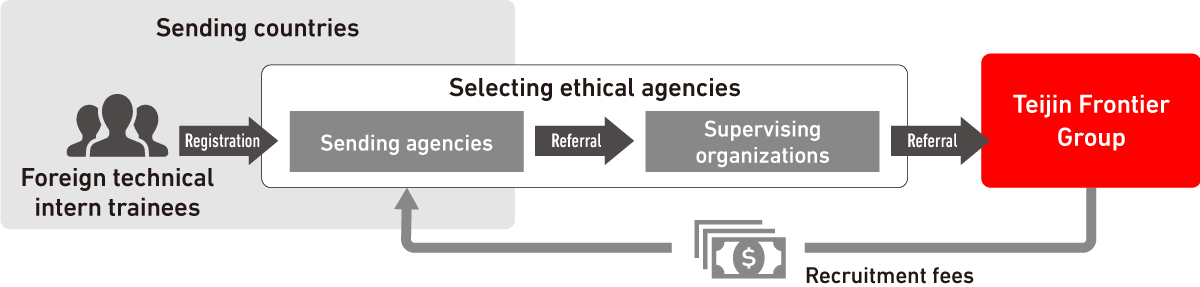
The Fibers & Products Converting Business, which has accepted foreign technical intern trainees for many years through the foreign technical intern training system, conducted an internal survey and discovered that trainees paid large fees to sending agencies in their home countries for coming to Japan. Since the practice of sending agencies requiring technical intern trainees to bear recruitment costs violates the International Labour Organization (ILO) Private Employment Agencies Convention, Teijin Frontier Group launched the ZERO-FEE PROJECT in FY2019. As the accepting entity, the Group now covers these fees to eliminate the financial burden on trainees. To ensure the effectiveness of the project, we accept technical intern trainees exclusively from ethical supervising organizations that support Teijin Frontier Group's philosophy and disclose information on sending agencies' fees and related matters. Such subsidiaries also confirm directly with the foreign trainees that they have not paid such fees. We are also conducting periodic surveys on the treatment status of the foreign technical intern trainees employed by our suppliers. We have confirmed that there were no serious violations of laws, such as the Japanese Labor Standards Act.
- *There are some instances where foreign trainees are forced to pay, before they come to Japan, a local recruitment firm their recruitment costs that were incurred during the local recruitment process. In some cases, trainees are forced to pay amounts that are equivalent to years of income. As a result, foreign trainees often need to earn as much as possible, which can lead to problems such as long working hours at their own request and disappearance just before returning to Japan.
Engagement and Dialogue with Stakeholders
We place great importance on dialogue with a variety of stakeholders, including employees, customers, suppliers, medical professionals and patients, and local communities. Through surveys, questionnaires, the operation of a reporting contact point, and other methods, we collect opinions and feedback, helping us better understand the human rights risks associated with our business and improve our response to them.
Response and Use of Comments Received by Counseling and Reporting Center (Remediation)
The Teijin Group has established a consultation and reporting desk for employees of Group companies. Teijin's website also provides a contact point for receiving reports from persons other than employees of Teijin Group companies, such as suppliers. These measures ensure that problems are addressed promptly and prevented from recurring. The table below shows the number of harassment cases among received internal reports. None of the reports constituted a serious violation of human rights. The Teijin Group believes a certain number of reports is appropriate. Each reported case is reviewed and handled appropriately based on its circumstances. Furthermore, Teijin Frontier launched the "Teijin Frontier Supplier Hotline" in July 2025 as a grievance mechanism. Through this hotline, a partnered, impartial third-party organization receives consultations ranging from employment, working environments, to compliance, from employees within and outside Japan, and provides appropriate responses. This initiative aims to maintain and improve human rights and labor environments throughout the entire supply chain.
| Japan | Europe | USA | Asia | Total | |
|---|---|---|---|---|---|
| FY2022 | 18 | 8 | 11 | 0 | 37 |
| FY2023 | 28 | 5 | 10 | 1 | 44 |
| FY2024 | 51 | 2 | 22 | 1 | 76 |
| FY2025 | 59 | 6 | 2 | 2 | 69 |
Teijin Group Modern Slavery & Human Trafficking Statement
The statement is made in accordance with the U.K.'s Modern Slavery Act which came into force in the United Kingdom in 2015.