
Summary of Corporate Governance
Basic Concept
In accordance with the basic mission of the Teijin Group to continually increase its corporate value,the Group is working to strengthen corporate governance to fulfill its responsibilities to variousstakeholders. The Group is striving to establish and strengthen an effective corporate governance system based on the principles of improving transparency, ensuring fairness, speeding up decisionmaking, and ensuring the objectivity of monitoring and supervision through a Board of Directors and Corporate Officer System in which at least half of the members are independent outside directors, an Audit & Supervisory Committee in which the majority of members are Independent outside directors, and a Nomination Advisory Committee and Compensation Advisory Committee in which the majority of members are independent outside directors. The Group has also formulated and published the Teijin Group Corporate Governance Guide, which sets forth guidelines for corporate governance.
Status of Compliance with the Japan's Corporate Governance Code
The Company complies all Principles of the Corporate Governance Code. Please refer to Corporate Governance Report for details.
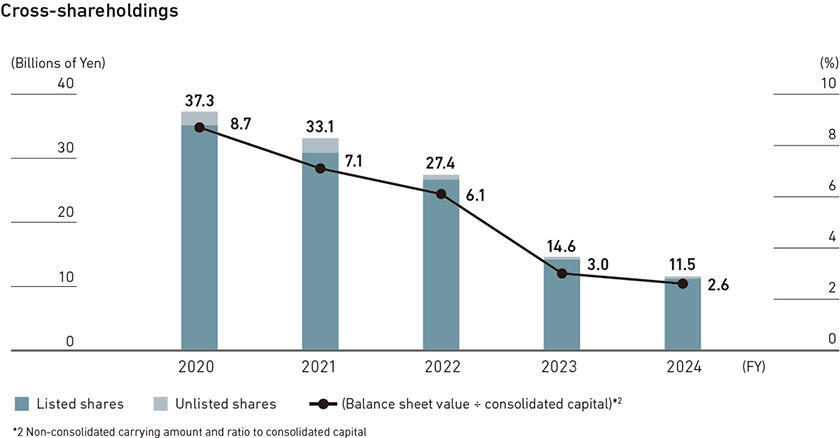
Cross-Shareholdings
(1) Basic Policy Concerning Cross-Shareholdings
The Company holds shares of issuing companies that it has determined to be instrumental in increasing its corporate value over the medium- to long- term, with the objective of maintaining and strengthening transactions, promoting business alliances with them and so on.
Each year, the Board of Directors reviews whether or not it is appropriate to hold shares based on an examination of the holding purpose and rationality for each individual stock from a medium- to long-term perspective.
In these reviews, the Board of Directors takes into account a comprehensive range of factors, including, without limitation, significance from a management strategy standpoint and business relationships, in addition to comparing dividends, transaction amounts, and other quantitative impacts against the cost of capital.
Based on the results of these reviews, the Company proceeded with the sale of the shares deemed to have diminished significance. During FY2024, the Company sold all shares of two specific investment stocks and two deemed investment stocks (with one stock overlapping), as well as part of the shares of two specific investment stocks. The total sale value amounted to 5.5 billion yen, out of which 3.6 billion yen was from deemed investment stocks.
The Company will continue discussions with the companies the shares of which the Company currently holds, and in principle, will endeavor to sell all of the shares of the listed companies.
In addition, whenever the shareholders of cross-shareholdings indicate their intention, such as intention to dispose of their
shares of the Company, the Company handles the matter appropriately without interfering with disposal of such shares.
- *The selling price is the amount of the listed shares sold by the Company (non-consolidated basis)
(2) Standards for the Exercise of Voting Rights Related to Cross-Shareholdings
In exercising the voting rights related to the shares that the Company has decided to hold, the Company confirms each proposal from the perspective of its increasing corporate value and shareholder value of the issuing companies over the medium- to long- term and determines whether to vote for or against.
For proposals that may have a significant impact on the corporate value of the investee companies, the Company collects and examines information with particular attention paid.
Major Initiatives for Strengthening Governance
| 1999 |
|
|---|---|
| 2003 |
|
| 2012 |
|
| 2015 |
|
| 2021 |
|
| 2022 |
|
| 2023 |
|
| 2024 |
|
| 2025 |
|
Organization Structure: A Company with an Audit & Supervisory Committee
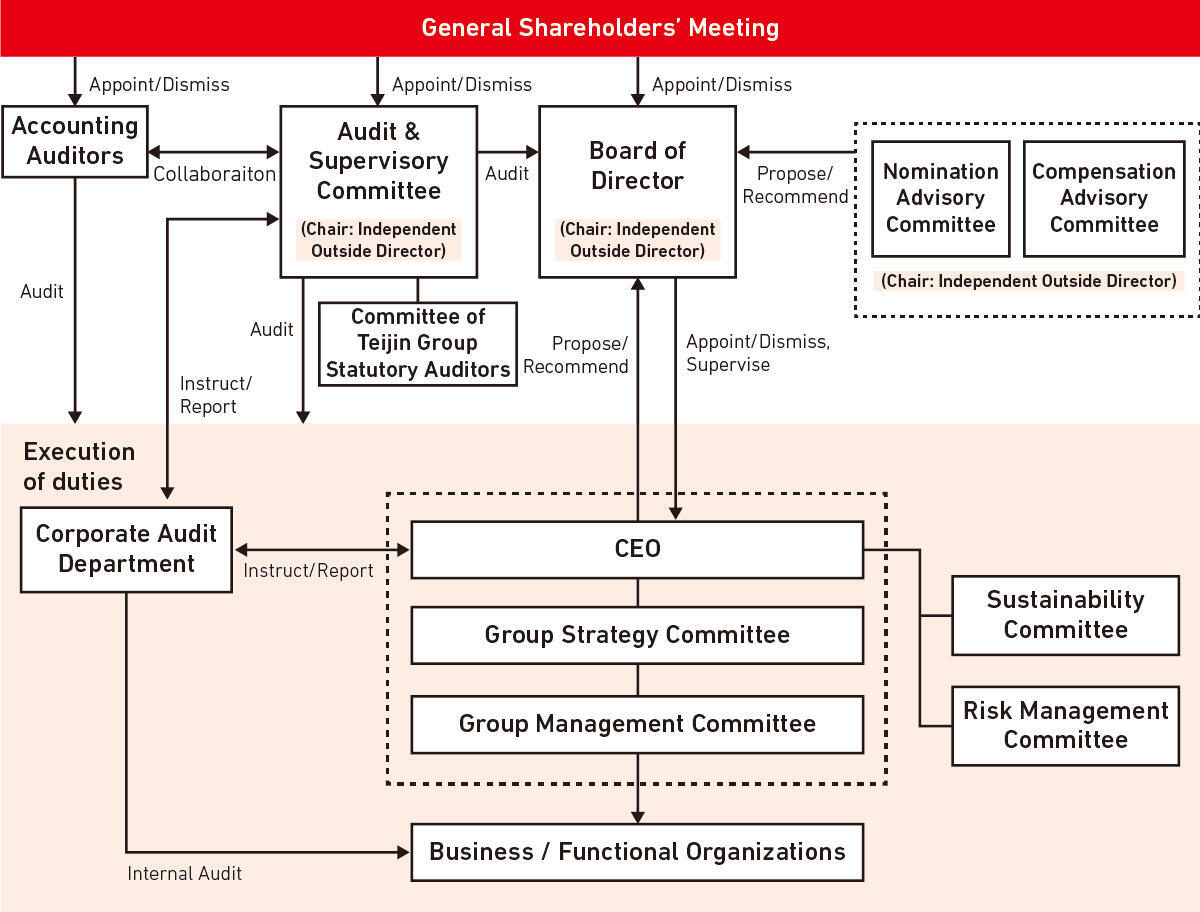
The Teijin Group has a policy of adopting the most appropriate corporate governance structure for achieving the Company's objectives and reviewing the structure as and when necessary in response to changes in social and legal environments. In accordance with this policy, in June 2025 we made the transition to a Company with an Audit & Supervisory Committee.
This shift will allow the Company to expand the delegation of authority from the Board of Directors to executive departments and speed up management-related decision-making. The Board of Directors will also strengthen debate on important management issues such as medium to longterm management strategies, and directors responsible for audits (Audit & Supervisory Committee Members) will get voting rights, in order to enhance the supervisory function of the Board of Directors.
(As of August 2025)
Executive Compensation
Teijin's policy for determining the individual compensation of its directors is reviewed annually for its appropriateness by the Compensation Advisory Committee, which consists of a majority of independent outside directors, and approved by resolution of the Board of Directors. These deliberations by the Compensation Advisory Committee take into consideration changes in the business environment as well as the opinions of shareholders and investors, while being informed by third-party organizations with extensive global experience and expertise. The term "Director" below refers to Directors who are not Audit & Supervisory Committee Members unless otherwise specified.
Basic Policy on Compensation Systems
- ⅰ.The system should motivate employees to achieve short-, medium-, and long-term management targets, as well as enhance awareness of contributing to medium- to long-term increases in profits and corporate value.
- ⅱ.The system should be closely linked to the Company's performance and highly transparent and objective.
- ⅲ.The system should be primarily focused on sharing value with stakeholders and enhancing shareholders-oriented management.
- iv.The system should maintain sufficient compensation levels and content to act as incentives to secure high-quality global management personnel.
Composition of Compensation for Directors
- ⅰ. The compensation for Inside Directors who concurrently serve as Corporate Officers is composed of performance-linked compensation (short-term incentive compensation), restricted stock compensation (medium- to long-term incentive compensation), and performance share units compensation (medium- to long-term incentive compensation) which are variable compensations, with the aim of providing an incentive to achieve short-term performance goals, achieve the medium-term management plan, and improve medium- to long-term corporate value, in addition to fixed basic compensation that is not linked with the performance of the Company.
For Inside Directors who do not concurrently serve as Corporate Officers, only basic compensation and performance-linked compensation, or only basic compensation is granted based on their appointed duties, and restricted stock compensation (medium- to long-term incentive compensation) and performance share units compensation (medium- to long-term incentive compensation) are not granted. - ⅱ. The compensation for outside directors is solely basic compensation that is not linked to the performance of the Company.
- ⅲ.The compensation for Directors who are Audit & Supervisory Committee Members is solely basic compensation based on their duties.
Composition Ratio of Executive Compensation
The compensation of Internal Directors who serve concurrently as executive officers is determined as follows.
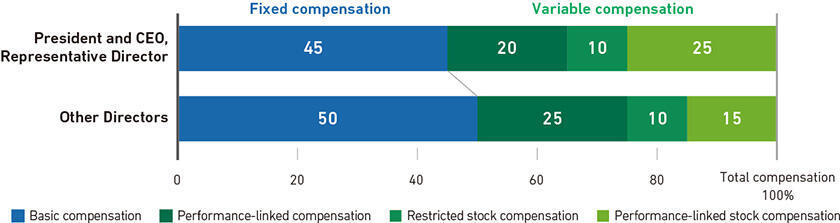
Fixed Compensation
| Basic compensation | A fixed amount of basic compensation is paid to directors according to their position and job grade. |
|---|
Variable Compensation
| Performance-linked compensation | To restore core profitability and promote business portfolio transformation, the Company pays performance-linked compensation based on individual performance targets including adjusted operating income, ROIC based on after-tax adjusted operating income and non-financial indicators (safety). |
|---|---|
| Restricted stock compensation | Restricted stock and share units equivalent to a standard amount are awarded based on position and job grade. |
| Performance-linked stock compensation | To enhance corporate value and shareholder value over the medium- to long- term, restricted stock and performance share units are awarded according to the degree of attainment of targets, based on the financial indicators of ROE and TSR (total shareholder return), and sustainability, assessed in terms of non-financial indicators (environment, DE&I, employee engagement). The weighting of these indicators is 40% for ROE, 30% for TSR, and 30% for sustainability. |
- *A stock unit indicates that the Company will pay an amount equivalent to the price of one ordinary share per unit.
Officer Compensation Amounts (FY2024)
| Position | Total compensation amount (millions of yen) |
Total compensation amount by type (millions of yen) | Number of officers receiving compensation |
|||
|---|---|---|---|---|---|---|
| Basic compensation |
Performance- linked compensation |
Restricted stock compensation |
Performance- linked stock compensation |
|||
| Directors (excluding outside directors) |
365 | 189 | 75 | 38 | 62 | 4 |
| Outside directors | 75 | 75 | - | - | - | 5 |
| Statuary auditors (excluding outside statutory auditors) |
77 | 77 | - | - | - | 3 |
| Outside statutory auditors | 45 | 45 | - | - | - | 3 |